
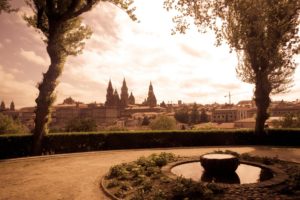
About the Camino de Santiago
The Camino de Santiago is a series of traditional pilgrimage routes leading to the city of Santiago de Compostela, the burial place of Saint James (Santiago in Spanish), the disciple of Jesus. In medieval times, pilgrims flocked from all our Europe to visit the tomb and receive blessing. The routes have been revived in the late 20th century and again pilgrims are drawn from around the world to make the journey on foot to Santiago.
The main route, the Camino Francés, begins on the French border in the sleepy town of St-Jean-Pied-de-Port and stretches over 800km (500 miles) to Santiago de Compostela near the western coast of Spain. The path follows the route laid out in the first pilgrim guidebook, the Codex Calixtinus, from the 12th century. Today, over 175,000 pilgrims make the trek along the Camino Francés.
While the Francés is the most famous pilgrimage route to Santiago, there are many other popular Camino routes. The Caminho Português (Spanish: Camino Portugués), the second most popular Camino route, starts in Lisbon, though many pilgrims walk from Porto, where they can choose between inland and coastal options to walk to Santiago. Beginning in Irún, the Camino del Norte follows Spain’s northern coast to Galicia. From this route, pilgrims can connect to the Camino Primitivo, the first historical pilgrimage route to Santiago. Other popular Camino routes include the Camino Inglés, a shorter route that travels just over 100km from Ferrol to Santiago; the Le Puy route, which begins in Le Puy, France, and arrives at the starting point of the Camino Francés; the Vía de la Plata, which begins in Sevilla; and the Camino Finisterre, which leads from Santiago to the coastal town of Finisterre.
The Story of St. James and the Camino
Legend and oral history recount that Saint James ministered in Spain before returning to the Holy Land, where he was martyred. Poor James was none too successful in his efforts, amassing a total of only seven followers. After his death in Jerusalem, the legend continues that his body was transported to Spain in a ship made of stone and steered by angels. The legend picks us again in 813 when the shepherd Pelayo saw a bright light in a field, which led him to the martyred disciples grave. A small chapel was built on the site which was later expanded in a marvelous cathedral.
In the Middle Ages, people from all over Christendom left their home and made the perilous journey to Santiago to visit the grave of Saint James. The main pilgrimage cities of that time were Rome, Jerusalem and Santiago, and Santiago was the primary destination for those traveling on foot (rather than by sea). Pilgrim hospices (lodging) were developed by churches along the routes for pilgrims to find shelter and food. The church encouraged pilgrimage, but likely had the ulterior motive of maintaining Christian control over Iberia at a time that the Muslim presence strong in the south and moving northward. A legend from the Battle of Clavijo in 844 says that Saint James appeared to the Christian army riding a white horse and charged into battle to defeat the Muslim armies. Saint James became known as “Santiago Matamoros,” or Saint James the Moor-Slayer.
There were many reasons that people set out from their home to journey to Santiago. Many were ill and dying, or had some kind of physical deformity that they wanted to ask Saint James to heal. Others traveled to ask for healing for a family member or loved one. Priests would sometimes “prescribe” a pilgrimage to Santiago as penance for someone who had committed a great sin. Perhaps others were simply seeking a great adventure after living most of their life in a small village.
The first pilgrimage guidebook to the Camino was published in the 12th century. The Codex Calixtinus or Liber Sancti Jacobi describes the popular French route, including much consideration to which water is safe to drink and how to avoid nefarious toll-collectors.
The pilgrimage routes to Santiago began to be revived in the 1980s, lead by zealous local leaders such as Elías Valiña Sampedro, Parish priest at O Cebreiro in Galicia. Infrastructure of pilgrim hostels, trail marking and other resources began to be developed and have continued to be refined.