
Camino Guidebooks - Village to Village Guides
  • Camino Guides
    • Camino Francés Guide
    • Camino Francés Maps
    • Camino Finisterre Guide
    • Camino Portugués Map Guide
    • Camino del Norte Map Guide
    • Camino Primitivo Map Guide
    • Camino Inglés Map Guide
    • Way of St. Francis
    • Book Reviews
    • Guidebook Website Links
  • Routes
    • About the Camino de Santiago
    • Camino Francés
    • Camino Finisterre
    • Camino Portugués
    • Camino del Norte
    • Camino Primitivo
    • Camino Inglés
    • Way of St. Francis
  • Gear
  • Plan
    • Camino FAQ
    • Choosing a Route
    • Sample Itineraries
    • When to Go
    • How to Get There
    • How to Pack for the Camino
    • Camino Gear Guide
    • Phone & Internet
    • Budgeting & Money
    • Pilgrim Passport & Compostela
    • Pilgrim Associations & Online Resources
    • Tours
    • Recommended Reading
    • Families, Children & Women
  • On the Way
    • Camino FAQ
    • Daily Routine
    • Sleeping: Albergues, Hotels, Camping
    • Food and Water
    • Maps, GPS & Trail Marking
    • Luggage Transfer
    • Spanish Phrasebook for the Camino
    • Health and Fitness
    • Bikes & Horses
  • About
    • About Village to Village Guides
    • Contact Us
    • LNT & Responsible Tourism
    • For Bloggers and Journalists
    • Disclaimer
  • Click to open the search input field Click to open the search input field Search
  • Menu Menu
  • Link to Facebook
  • Link to X
  • Link to Instagram
  • Link to Pinterest

Camino Routes

Camino de Santiago routes in Spain, Portugal and France

The Many Ways to Santiago

When most people think of the Camino de Santiago, they usually are picturing the most popular route, the Camino Francés (the route featured in the Martin Sheen film The Way). However, there are many Caminos leading to Santiago!

In Medieval times, pilgrims simply left their front door and walked to Santiago, using whatever roads and paths were safest and most direct. While today the Francés route is the most developed, other Camino routes also offer a wonderful pilgrimage experience.

Read more about the Camino’s history

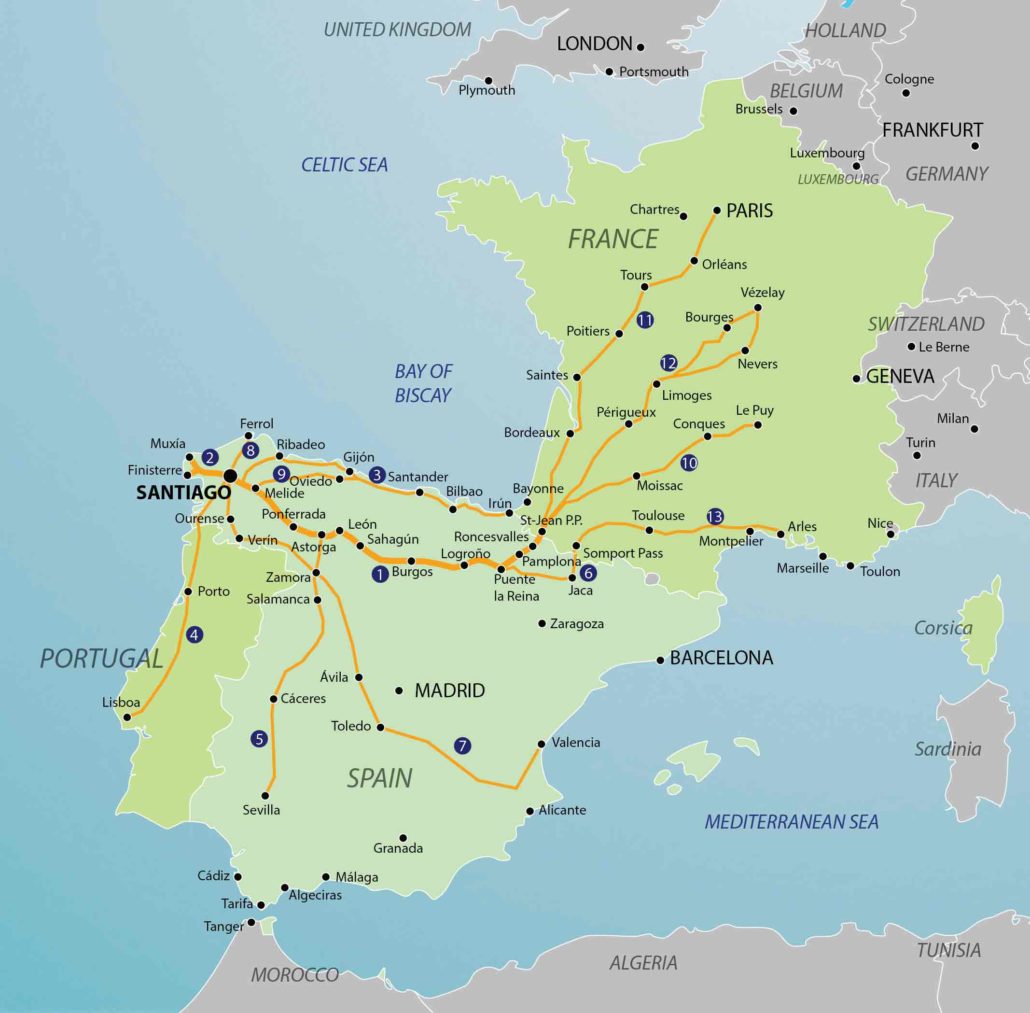
SPAIN and PORTUGAL

1) Camino Frances (800km, St-Jean-Pied-de-Port to Santiago)
2) Camino Finisterre (90km, Santiago to Finisterre and Muxia)
3) Camino del Norte (825km, Irún to Santiago)
4) Camino Portugués (610km, Lisboa to Santiago)
5) Vía de la Plata (1000km, Sevilla to Santiago)
6) Camino Aragonés (170km, Samport Pass to Puente la Reina)
7) Camino de Levante (1300km, Valencia to Santiago)
8) Camino Inglés (115km, Ferrol to Santiago)
9) Camino Primitivo (350km, Oviedo to Santiago)

FRANCE

10) Chemin de Le Puy (730km, Le Puy to St-Jean-Pied-de-Port)
11) Chemin de Paris (1000km, Paris to St-Jean-Pied-de-Port)
12) Chemin de Vézelay (900km, Vézelay to St-Jean-Pied-de-Port)
13) Chemin d’Arles (740km, Arles to Samport pass)

Many other connecting routes exist from various locations in Europe.

The Camino de Santiago on Ride With GPS

Read more

Camino Francés: RWGPS Collection

Camino Portugués: RWGPS Collection 

Camino del Norte: RWGPS Collection

Camino Primitivo: RWGPS Collection

Camino Inglés: RWGPS Collection

The Way of St. Francis: RWGPS Collection

Choosing a Camino Route

With the many pilgrimage routes available in Spain, Portugal, and France, it can be overwhelming to choose which route is right for you. Here are a few questions to help guide your exploration:

  • Do you want to walk with other people, or by yourself?
    The Camino Francés route is very popular and you are guaranteed to walk with many others during the popular seasons. The Camino Portugués is also quite popular north of Porto. On other less frequented camino routes (Camino Portugués south of Porto, Camino del Norte, Camino Primitivo, Camino Inglés), you’ll still encounter other pilgrims, but you’re more likely to have time to yourself, walking alone throughout the day. On every route, the last 100km to Santiago can become crowded!
  • Do you want to stay in pilgrim accommodations (inexpensive hostels) or do you prefer to have private accommodations, or to camp?
    The Camino Francés is the best set up for staying in inexpensive dormitory pilgrim accommodations each night, as there are many hostels and very frequent distances. The Camino Portugués, Camino del Norte, Camino Primitivo and Camino Inglés routes all have reasonably-spaced albergues; however, distances between albergues are greater in places than on the Francés, and some private accommodations may be necessary.

    Similarly, the style of albergue can be less formalized on routes other than the Francés. In Portugal, pilgrims have been known to stay in fire stations or share rooms in simple pensions; on the Camino del Norte, select municipal buildings or gyms are open to pilgrims during the high season (July/August); and on the Camino Primitivo, in Asturias, old schoolhouses have been repurposed as albergues. On all routes, in Galicia (where pilgrim traffic is heaviest), albergues are generally more frequently spaced and well organized.

    The Norte and Primitivo routes are more remote and so better suited for camping than the Francés route.

  • How much time do you have to walk?  Is it important for you to reach Santiago? What aspect of the Camino are you most interested in (mountain scenery, good wine, camaraderie)?
    View three itineraries of varying length to complete the Camino Francés (26 days, 31 days, 40 days).

    There are numerous Camino Portugués intineraries. Walk all the way from Lisboa (26 days); or start from Porto and continue to Santiago on the central, coastal, and/or spiritual routes for a manageable two-week journey.

    Our Camino Primitivo itinerary is 13 days from Oviedo to Santiago. The mountainous terrain is not for the faint-of-heart; but fit walkers can manage this route in two weeks.

    Consider walking from Irún to Santiago on one of our various Camino del Norte itineraries. Or, walk from Irún and connect to Oviedo from Villaviciosa for a rugged, but beautiful and historic, itinerary combining the Camino del Norte and Camino Primitivo.

    If you only have time for a week of walking, take a look at our comfortable Camino Inglés itinerary (6 days).

Share this:

  • Share on Facebook (Opens in new window) Facebook
  • Share on X (Opens in new window) X
  • Share on Pinterest (Opens in new window) Pinterest
  • Share on WhatsApp (Opens in new window) WhatsApp
  • Share on LinkedIn (Opens in new window) LinkedIn
  • Email a link to a friend (Opens in new window) Email

Camino Routes


  • • Camino Francés Interactive Map
  • • Camino Portugués
  • • Camino del Norte
  • • Camino Primitivo
  • • Camino Inglés
  • • Camino Finisterre

Links for Camino accommodations online, organized by V2V guidebooks stages.

V2V Camino Guides

V2V Mailing List

Search Search

Welcome to Camino Guidebooks by Village to Village Press!

We aim for this website to be a portal into all things Camino, with first-rate practical resources as well as inspiration photos and reflections. We are Camino pilgrims ourselves, having walked and biked various Camino de Santiago multiple various times. We hope our website and guidebooks help others to enjoy the rich experiences of the Camino in life-changing ways, as we have. If you enjoy this website, we think you will also enjoy our Camino guidebooks. This Camino Francés and Finisterre book is chock-full of practical resources, with excellent maps, town amenities, historical information, and prices and amenities of a wide variety of accommodations along the way. In short, this is the guidebook we wish we’d had as pilgrims!

Terms of Use

User assumes all risk and liability for any action in relation to usage of information and routes on caminoguidebook.com and RideWithGPS, including if actions result in injury, death, loss or damage of personal property or other complications. Village to Village Press, LLC, its partners, associates, and contributors accept no liability. Route information and advice is provided as a planning resource only, and is not guaranteed to be accurate or complete, and in no way should replace your own due diligence, research, and safety precautions. All users are advised to check current conditions before embarking on any route, including weather, surface conditions and closures. Users should obey all laws including public and private land usage restrictions and guidelines and carry adequate safety and navigational equipment.

Affiliate Links

Amazon.com and Booking.com affiliate links generate income to keep this site going at no additional cost to you. Thanks for exploring the Camino with us!

© Copyright 2009-2023 -Camino Guidebooks, Village to Village Press, LLC - Enfold Theme by Kriesi
  • Link to Facebook
  • Link to X
  • Link to Instagram
  • Link to Pinterest
Scroll to top Scroll to top Scroll to top